
Quantity (energy) and quality (temperature, exergy)
-
quantity and quality: the importance of temperature level (exergy)
A breakdown by temperature levels of both energy demand and residual energy is crucial basic information as a starting point for energy optimisation:
- this breakdown is used in pinch analysis and the subsequent design of heat recovery systems (heat exchanger networks, heat pump applications)
- for many energy efficient and renewable technologies, both technology choice and conversion efficiency of a specific technology is strongly depending on temperature (solar thermal, heat pumps, CHP, ...). As a general rule, providing energy at higher temperature (exergy) requires more complex and costly technologies, at a lower efficiency.
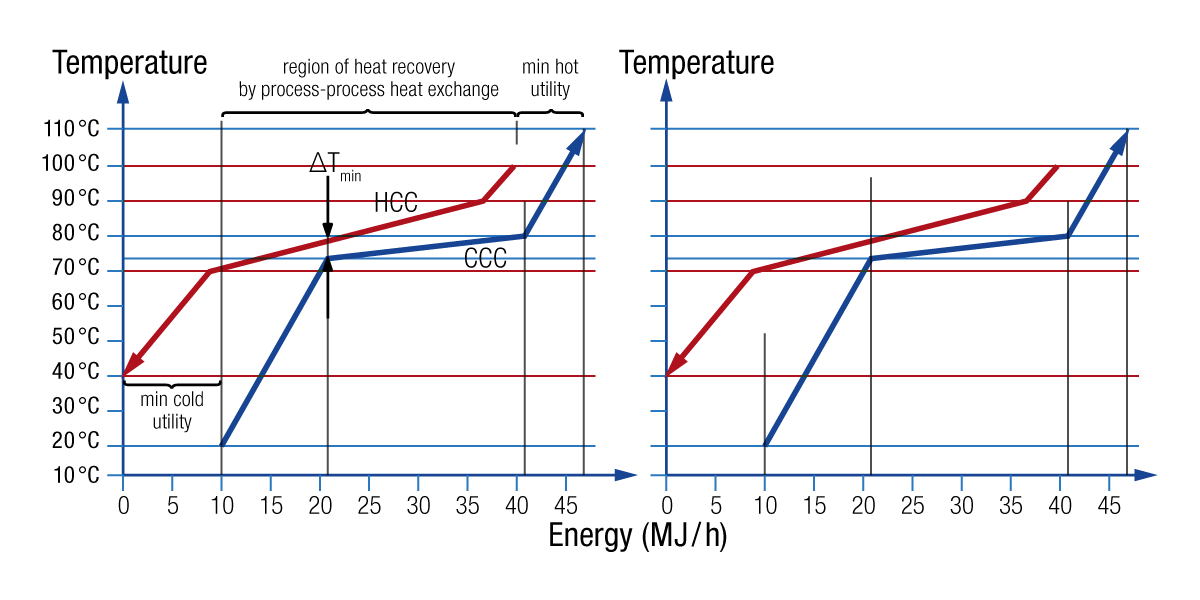
Hot and cold composite curves representing quantity and quality of heat sources and heat demand in classical pinch analysis
-
standard for the accountancy of energy flows – process vs. supply
In the context of optimising temperature levels, it is basic to distinguish between the real needs in some process, and how this needs (energy) are supplied in the specific design of some supply system:
- a classical example for illustrating this difference is an industrial washing process taking place e.g. at 70 °C, but receiving heat supply from a steam network at 160 or 180 °C.
- space heating of buildings requires maintaining building indoor temperature at around 20 °C. The supply temperature, nevertheless, may vary between 35 °C and more than 80 °C depending on the implemented heating system (floor heating vs. radiator heating in old buildings), and if supply is provided by high temperature district heating networks, even temperatures far above 100 °C may be required.
EINSTEIN provides a standard for the accountancy of energy flows in a project, including a system of definitions of quantities, subsystem boundaries and temperature levels, in order to explicitly take account of this difference of process and supply (temperatures) and so making the optimisation potential visible which can be achieved by changing distribution systems.
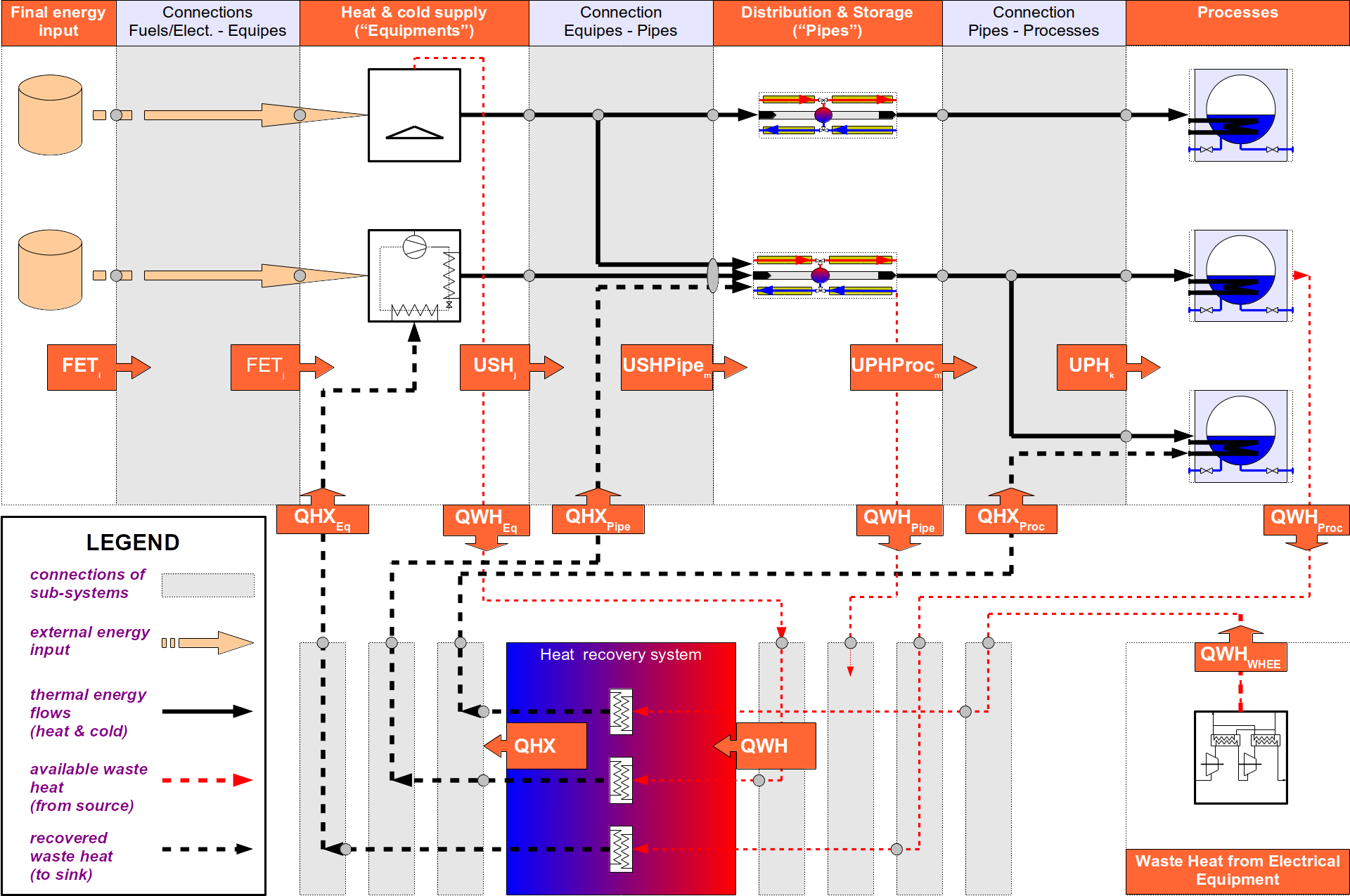
EINSTEIN standard for the accountancy of energy flows in a project, including a system of definitions of quantities, subsystem boundaries and temperature levels